Policy Brief
Rebuilding International Health Governance on Ethics, Evidence and Sovereign Responsibility
Overview
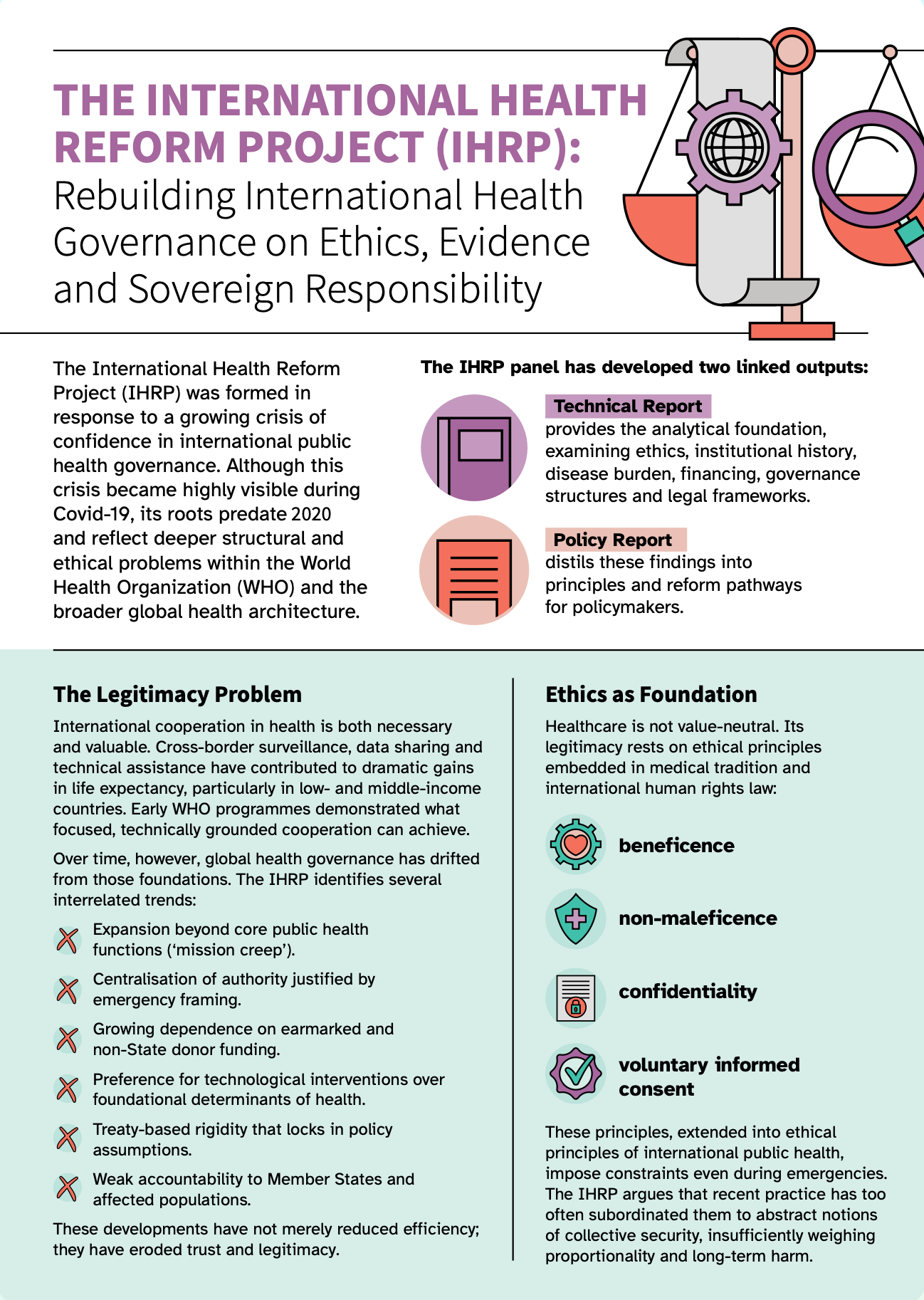
The International Health Reform Project (IHRP) was formed in response to a growing crisis of confidence in international public health governance. The project identifies structural and ethical problems within the WHO and broader global health architecture that predate COVID-19, including mission creep, centralisation of authority, dependence on earmarked funding, preference for technological interventions, treaty-based rigidity, and weak accountability.
The IHRP has developed both a Technical Report (examining ethics, institutional history, disease burden, financing, governance structures and legal frameworks) and a Policy Report (distilling findings into principles and reform pathways). The project is designed to inform upcoming debates around WHO leadership transitions and institutional reform, arguing that effective international cooperation requires legitimacy grounded in ethics, evidence, proportionality and respect for sovereign responsibility.
Key Findings
- Global health governance has drifted from core public health foundations through mission creep, centralisation, and growing dependence on earmarked non-State donor funding
- Recent practice has subordinated core ethical principles (beneficence, non-maleficence, confidentiality, voluntary informed consent) to abstract notions of collective security
- Pandemics account for a relatively small share of long-term global mortality compared with endemic infectious and non-communicable diseases
- Historical life expectancy gains have primarily come from sanitation, nutrition, antibiotics and primary care, not emergency architectures
- Subsidiarity is the missing organising principle - decisions should be taken at the lowest level capable of acting effectively
- International cooperation derives legitimacy from voluntary state participation, which weakens when authority drifts to centralised technocratic bodies
- The exit of the United States, funding constraints, and the pending election of a new WHO Director-General in July 2027 presents a critical moment for institutional reassessment