The Right to Health Sovereignty: Technical Report
A comprehensive analysis of structural deficiencies in pandemic response and proposed organizational reforms to restore public health primacy
Overview
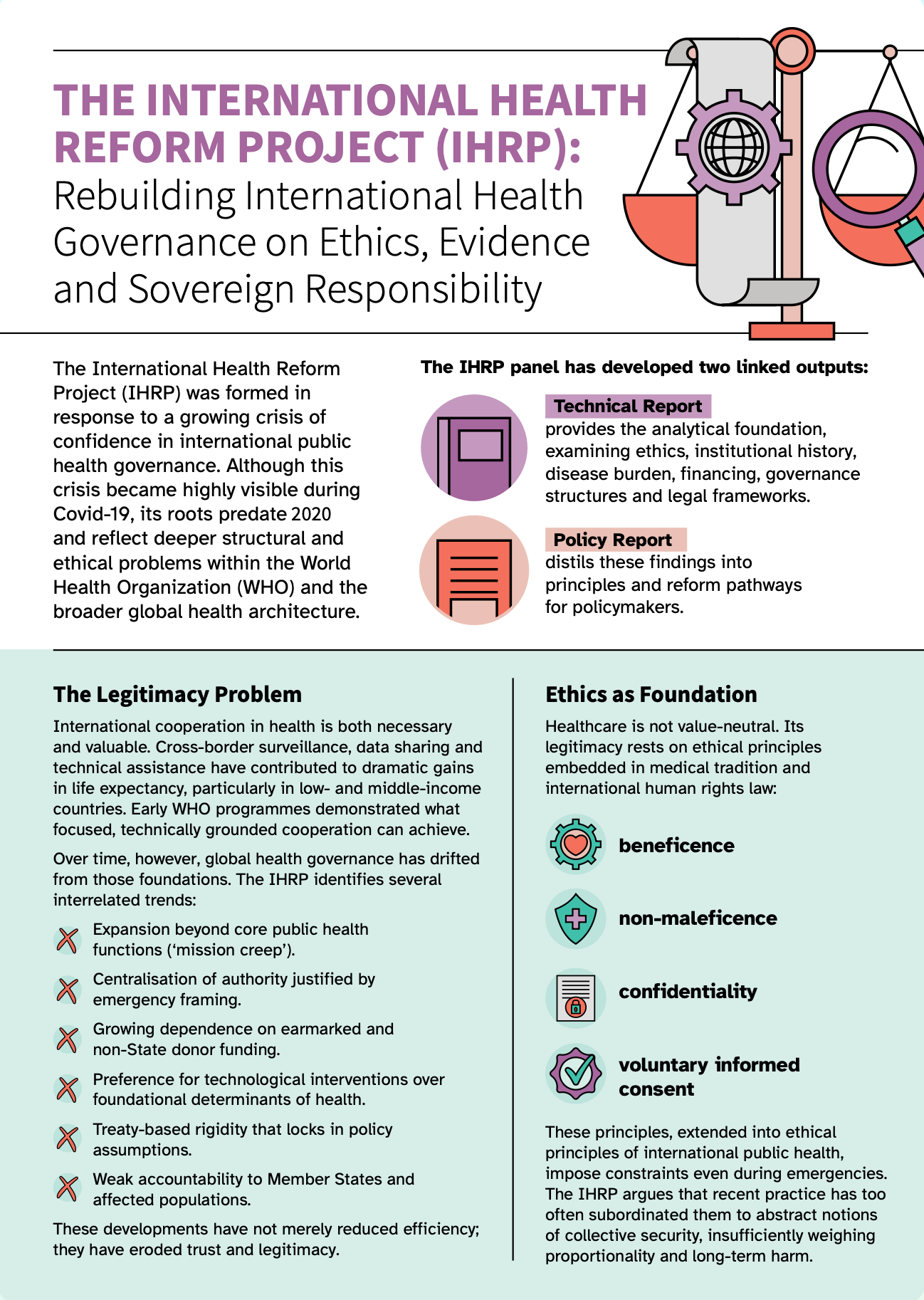
This document examines fundamental structural problems within the World Health Organization (WHO) that have undermined effective pandemic preparedness and response. It identifies key deficiencies including conflicts of interest, inadequate funding mechanisms, the abandonment of evidence-based policymaking, and the prioritization of pharmaceutical interventions over broader public health measures. The analysis demonstrates how these systemic issues contributed to failures during the COVID-19 pandemic and other recent health crises.
The authors propose comprehensive reforms centered on restoring the WHO's founding principles as articulated in its Constitution. Recommendations include restructuring governance to eliminate conflicts of interest, returning to core public health competencies, reestablishing evidence-based decision-making processes, and refocusing on health equity and social determinants of health. The document argues that without fundamental organizational reform, the WHO will continue to fail in its primary mission of protecting global health security.
Key Findings
- The WHO has progressively abandoned its constitutional mandate to prioritize broad public health approaches in favor of narrow pharmaceutical interventions driven by private sector interests
- Current funding structures create fundamental conflicts of interest, with significant portions of WHO budget controlled by private entities and earmarked for specific programs rather than core functions
- Pandemic preparedness frameworks have been built on flawed modeling assumptions that consistently overestimate mortality risks and justify disproportionate responses
- The COVID-19 response revealed systematic failures in evidence-based policymaking, with recommendations often contradicting established public health principles and scientific evidence
- Health equity has been severely undermined by pandemic policies that disproportionately harmed vulnerable populations while benefiting pharmaceutical industry profits
- The WHO's credibility and effectiveness have been substantially damaged by its deviation from founding principles and susceptibility to commercial influence
- Current reform proposals such as the Pandemic Treaty fail to address fundamental structural problems and may further entrench problematic approaches
Recommendations
Restructure WHO governance to eliminate conflicts of interest by prohibiting private sector funding and influence in policy-making processes
Return to comprehensive primary healthcare approaches as outlined in the Alma Ata Declaration rather than narrow vertical disease programs
Reestablish rigorous evidence-based decision-making processes with transparent evaluation of interventions and systematic consideration of harms versus benefits
Refocus pandemic preparedness on realistic risk assessment rather than worst-case scenario modeling that drives disproportionate responses
Prioritize health equity and social determinants of health in all policies, ensuring interventions do not exacerbate existing inequalities
Restore meaningful democratic accountability through enhanced roles for Member States and civil society in WHO governance
Implement comprehensive reforms to funding mechanisms ensuring sustainable core budget support independent of private interests